

What’s the difference between Irish Spring, Dove, other store-bought “soap” bars, and real handmade soap?
The personal care aisles are packed with sleek, colorful bars labeled as “beauty bars,” “cleansing bars,” and “dermatologist recommended.” But here’s the truth: most of these aren’t soap at all. They may look like soap, but in reality—legally and chemically—they’re not. They’re syndet bars, meaning synthetic detergent bars. These bars are mass-produced with industrial surfactants, fillers, preservatives, and fragrance chemicals designed for foam and shelf life, not skin health.
Real handmade soap—like the ones crafted by RYM Products—is made using natural oils, butters, and traditional saponification. No synthetic detergents. No petroleum surfactants. No mystery chemicals hiding under the word “fragrance.”
To truly understand the difference, let’s start by looking at what’s actually inside a typical Irish Spring bar.
While they promise softness and moisture, syndet bars are built on a foundation of laboratory-engineered chemicals, not natural oils. Once you understand what’s really in them — and what they do to your skin — you’ll see why making the switch to natural soap from RYM Products is the best decision you can make for your skin and the planet.
What Are Syndet Bars, Really?
The word syndet combines synthetic and detergent — which should already tell you what’s inside.
Instead of being crafted through the time-honored process of saponification (mixing lye with natural oils to create real soap), syndet bars are made from man-made surfactants — harsh cleansers that mimic soap’s behavior without offering its natural benefits.
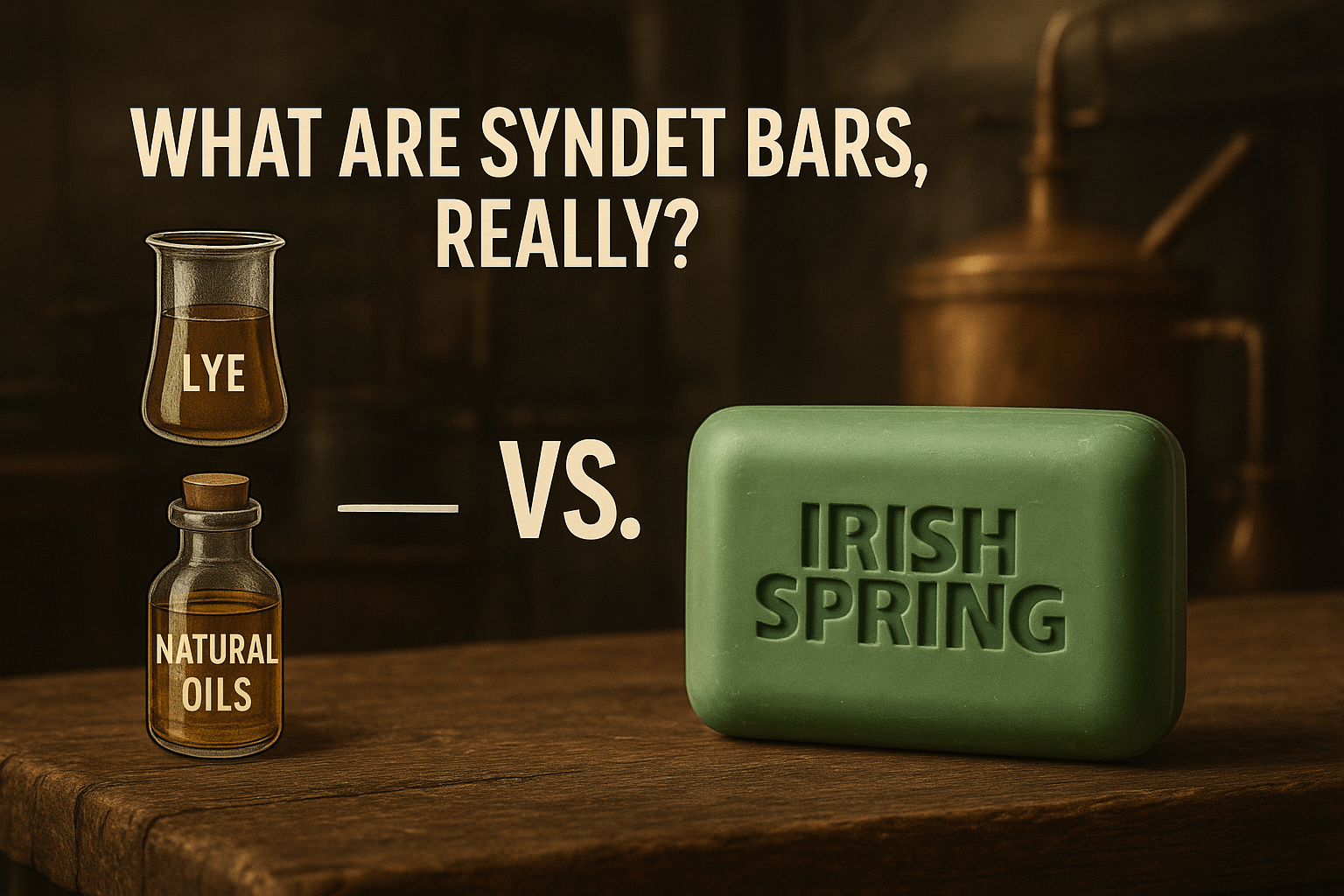
What’s actually inside an Irish Spring bar?
Here are the ingredients commonly found in the “Original Clean” formula:
-
Sodium Lauryl Sulfate (SLS) – harsh detergent known to strip natural oils
-
Sodium Tallowate – industrially processed beef fat
-
Sodium Palmate – highly processed palm-based surfactant
-
Sodium Cocoate – harsh coconut-derived detergent
-
Fragrance – a chemical cocktail with undisclosed ingredients
-
FD&C Green Dyes – synthetic petroleum-derived colorants
-
Titanium Dioxide – whitening agent
-
Tetrasodium EDTA – preservative and penetration enhancer
-
Tetrasodium Etidronate – anti-soap-scum additive
-
Glycerin (removed) – extracted and sold separately
-
Petrochemical-derived surfactants
These compounds remove dirt — but they also strip away your skin’s natural oils and can leave your skin dry, tight, and irritated.
Why Syndet Bars Are Bad for Your Skin
1. They Disrupt Your Skin’s Natural Barrier
Your skin has a delicate outer layer called the acid mantle — a slightly acidic barrier that keeps moisture in and bacteria out.
Syndet bars, despite claims of being “pH-balanced,” often disturb this layer because they rely on chemical bufferingrather than natural harmony. The result?
Dryness, flakiness, irritation, and increased sensitivity — especially if you already suffer from eczema or dermatitis.
2. Hidden Ingredients and Harsh Chemicals
Unlike small-batch soapmakers, large corporations aren’t required to fully disclose every component of their proprietary “fragrance” blends or chemical additives.
That means a syndet bar can include:
-
-
Preservatives like parabens
-
Synthetic colors and dyes
-
Fragrance stabilizers and masking agents
-
These hidden chemicals can cause allergic reactions, redness, or long-term sensitization — even if they’re labeled “for sensitive skin.”
3. They’re Bad for the Environment
While natural soap is biodegradable, syndet bars are not. Their synthetic detergents are derived from petrochemicals — byproducts of the oil industry.
When rinsed down your drain, these compounds don’t fully break down, often accumulating in waterways and harming aquatic ecosystems.
Even the packaging of syndet bars often uses non-recyclable plastic and industrial production processes that leave a much larger carbon footprint compared to handcrafted, low-waste alternatives.
4. Misleading Marketing Tactics
Have you ever noticed that certain “soap” brands never actually use the word soap on their labels?
That’s because they legally can’t — they’re not soap at all.
The FDA classifies real soap as a product made primarily from alkali (lye) and natural fats or oils. Syndet bars don’t qualify because their cleaning power comes from synthetic surfactants, not saponified oils.
Yet, many brands hide behind phrases like:
-
-
“Moisturizing beauty bar”
-
“Dermatologist tested”
-
“pH balanced”
-
“Gentle for sensitive skin”
-
These marketing lines sound trustworthy — but they’re designed to make you overlook the fact that you’re using a synthetic detergent block, not a true soap.
The Beauty of Real, Natural Soap
Unlike syndet bars, natural soap is created through a process that’s been around for thousands of years — saponification— where oils and lye react to form soap and glycerin.
When done right, this process yields a bar that:
-
Gently cleans without stripping the skin
-
Retains glycerin, a natural humectant that draws moisture into your skin
-
Is biodegradable and eco-conscious
-
Can be customized with plant-based oils, butters, clays, and essential oils
Some common natural soap ingredients that benefit the skin include:
-
Olive oil – deeply moisturizing and soothing
-
Shea butter – rich in vitamins and fatty acids
-
Coconut oil – excellent natural cleanser with antibacterial properties
-
Rice bran oil – improves skin elasticity
-
Castor oil – adds luxurious lather and conditioning
Together, these oils nourish rather than deplete your skin — a difference you can feel immediately.
RYM Products: Where Real Soap Still Means Something
At RYM Products, we do things differently.
Each soap bar is handcrafted in small batches using traditional methods, clean ingredients, and creative inspiration drawn from music, culture, and nature.
Our soaps:
-
Contain no synthetic detergents or harsh chemicals
-
Are 100% biodegradable and cruelty-free
-
Retain all the natural glycerin produced during saponification
-
Use phthalate-free fragrances and skin-safe colorants
-
Are cured slowly to ensure a rich, long-lasting lather and mild feel
Soap bars like Forest of Shadows, Café Con Leche and Blue Oasis bring personality and artistry to skincare — proving that natural doesn’t have to be boring.
Each bar tells a story and invites you into the ritual of real self-care — something no syndet bar can ever replicate.
Natural Soap vs Syndet Bar: The Clear Winner
| Feature | Natural Soap (RYM Products) | Syndet Bar |
|---|---|---|
| Main Ingredients | Natural oils, butters, lye | Synthetic surfactants, petrochemicals |
| Process | Traditional saponification | Industrial chemical blending |
| Skin Feel | Soft, hydrated, balanced | Tight, dry, sometimes irritated |
| Glycerin | Naturally retained | Removed and sold separately |
| Eco-Friendliness | Fully biodegradable | Often non-biodegradable |
| Transparency | Full ingredient list | Hidden chemicals under “fragrance” |
| Customization | Handmade artistry | Mass-produced uniformity |
The difference is clear: syndet bars clean your skin, but at a cost.
Natural soaps nourish, protect, and respect both your skin and the planet.
Final Thoughts: Choose Real, Not Synthetic
Syndet bars might be marketed as modern “science-based skincare,” but in reality, they’re detergents in disguise.
Their chemical formulas strip your skin’s natural defenses, create waste, and feed into greenwashing trends that value profit over people.
When you choose RYM Products, you’re not just choosing a soap bar — you’re choosing authenticity, craftsmanship, and sustainability.
Your skin will feel the difference after just one wash.
Because your body deserves more than fake soap.
Choose real. Choose RYM Products.


